Bodø–Lofoten–Tromsø
Ferry to Lofoten and onward north — midnight sun in summer, northern lights in winter.
The facts
| stops | 20 |
| End to end | 14 h |
| Travel by | kollektiv, bil, buss |
| Home | Bodø → Tromsø |
When it is busy
| Month | When it is busy |
|---|---|
| January | 34 % |
| February | 44 % |
| March | 46 % |
| April | 31 % |
| May | 40 % |
| June | 79 % |
| July | 100 % |
| August | 83 % |
| September | 51 % |
| October | 44 % |
| November | 42 % |
| December | 37 % |
Busiest: July. Quietest: April. Guest arrivals per month as a share of the route's own busiest month. Figures from Statistics Norway, averaged over seven full years. They count people who stay overnight, so day trippers and cruise passengers are not included.
Stops along the way
- Bodø · 0 h
European Capital of Culture 2024, the end of the railway and the ferry port for Lofoten. - Moskenes · 3.5 h
The ferry berth where Lofoten begins — three hours across the Vestfjord from Bodø, the peaks rising straight out of the sea. - Å i Lofoten · 3.8 h
The last place on the road and the last letter of the Norwegian alphabet — stockfish racks, fishermen's cabins and the Norwegian Fishing Village Museum. - Reine · 4 h
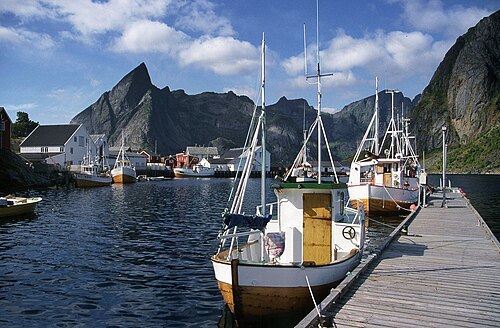
Red cabins on a spit in the Reinefjord, with Olstinden rising 700 metres directly behind — Norway's most photographed fishing village. - Hamnøy · 4.1 h
Lofoten's oldest fishing village. The bridge here gives the photograph everyone knows: cabins in the foreground, Festhelltinden behind. - Reinebringen · 4.2 h
1566 sherpa-built stone steps to 448 m, looking straight down on Reine and the fjord arms between the peaks. - Nusfjord · 4.8 h
One of Norway's best-preserved fishing villages, near-unchanged since the 1800s, in a harbour so narrow it is barely visible from the road. - Ballstad · 5.2 h
One of Lofoten's largest working fishing villages — the trade as it actually is, rather than as a museum. - Leknes · 5.4 h
Vestvågøy's commercial centre and practical hub — airport, shops and buses onward in every direction. - Haukland · 5.7 h
White sand and turquoise water beneath 400-metre peaks — Arctic Caribbean, with the water topping out around 12 °C. - Lofotr vikingmuseum · 6 h
A reconstruction of the largest chieftain's longhouse found in Scandinavia — 83 metres long, built over the excavation at Borg. - Henningsvær · 6.8 h
A fishing village spread across several islets and linked by bridges — and a football pitch wedged between the stockfish racks. - Svolvær · 7.3 h
Lofoten's capital, with the Svolvær Goat rock pinnacle over the town and boats out to the Trollfjord. - Stokmarknes · 8.6 h
Birthplace of the Hurtigruten coastal express. Its museum has the entire MS Finnmarken standing on dry land, under a roof. - Sortland · 9.3 h
"The blue town" — the houses were painted in shades of blue as an art project, and the colour stuck. - Andenes · 11 h
At the far tip of Andøya, where the continental shelf drops away and sperm whales gather — whale safaris all summer. - Harstad · 10.8 h
Northern Norway's second city, with the 13th-century Trondenes church and a German coastal battery holding the world's largest land-based guns. - Finnsnes · 12.6 h
The bridge across to Senja, "Norway in miniature" — and the last stop before the run into Tromsø. - Fløya · 14.2 h
The cable car lifts you to 421 m in four minutes; the path continues to 671. From here the midnight sun stands over the whole of Tromsøya. - Tromsø · 14 h
The world's northernmost university city — the Arctic Cathedral, polar history, and the aurora directly over the centre from September to March.